To Listen While On-The-Go
Virtual cycling platforms have revolutionized how cyclists train indoors, transforming monotonous basement sessions into dynamic, interactive experiences that rival outdoor riding. Whether you’re a competitive racer chasing marginal gains, a fitness enthusiast seeking structure and motivation, or a casual rider looking to stay active during harsh weather, these digital platforms offer unprecedented opportunities to ride, train, and connect with cyclists worldwide – all from the comfort of your home.
This comprehensive guide explores everything you need to know about virtual cycling platforms, from understanding what they are and how they work to choosing the right platform for your goals, budget, and riding style. The team at Pedal My Way evaluated 20 specific virtual cycling platforms for performance, user experience, and potential user value. This guide explains our data.
PEDAL MY WAY NEWSLETTER
Weekly training tips, cycling strategies, and fitness insights for sustainable performance.
No spam—just actionable guidance to help you train smarter.
Table of Contents
What Are Virtual Cycling Platforms?
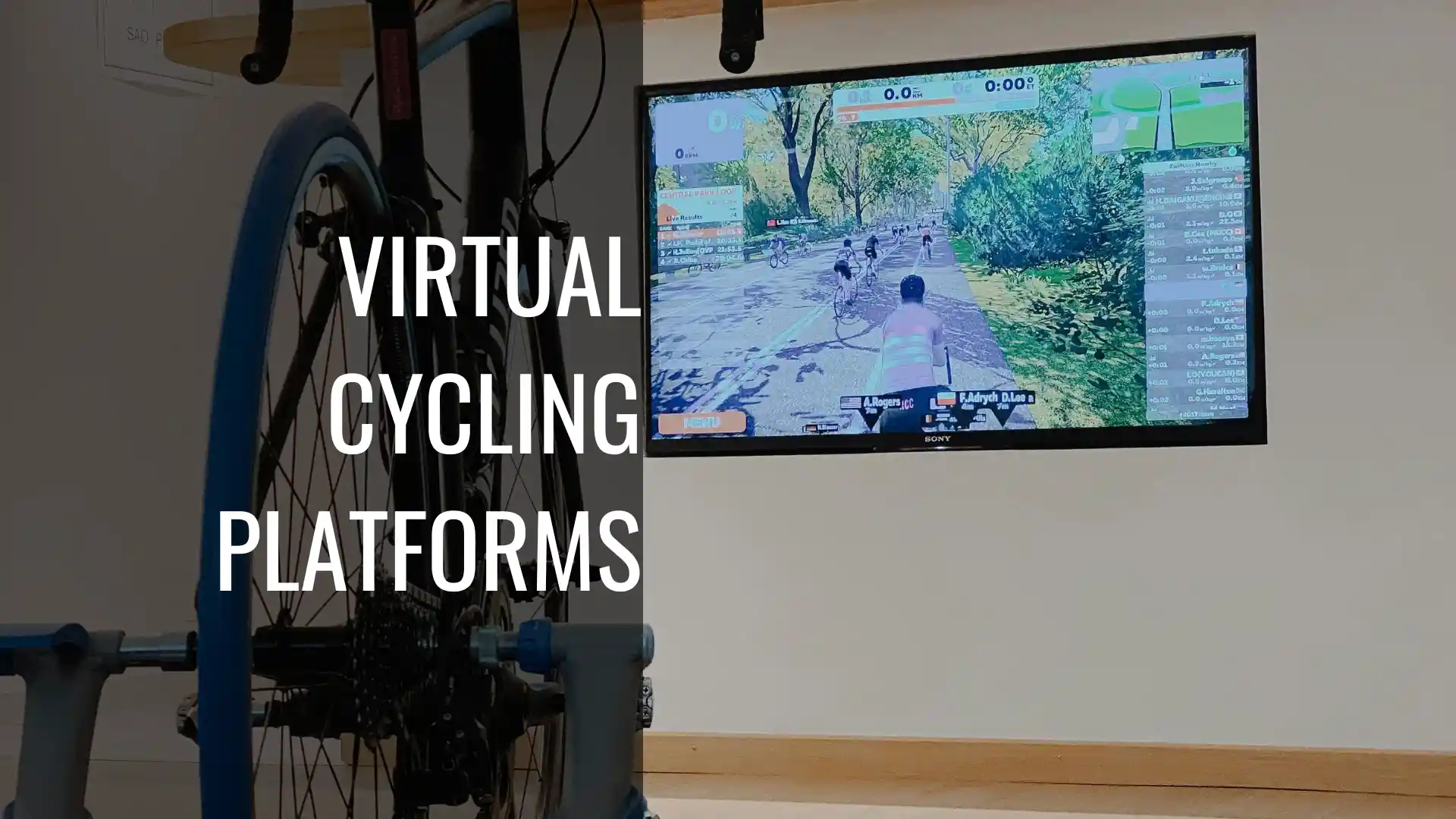
The technology works by pairing your smart trainer or power meter with the platform via Bluetooth or ANT+. As you ride through virtual worlds or follow structured workouts, the platform adjusts your trainer’s resistance to match hills, descents, and terrain changes. Your avatar moves through the digital environment based on your actual power output, creating a gamified yet authentic cycling experience.
Popular Virtual Cycling Platforms in Our Reviews
| Platform | Core Philosophy | Key Features | Visual Style | Best For | Pedal My Way Score |
|---|---|---|---|---|---|
| ZWIFT | Unapologetic gamification. Treats cycling as a sport enhanced by digital layers (XP, power-ups). |
| Vibrant, stylized, high-end mobile game graphics. Cluttered, busy interface. | The social butterfly, competitive racers, and riders needing high-stimulation distraction. | 8.5/10 |
| TRAINERROAD | “Get Faster.” Structured training focusing purely on physiological adaptation without virtual distractions. |
| Austere and utilitarian. Dominated by a single blue workout bar chart. | Data-disciplined athletes, time-crunched professionals, and self-coached racers prioritizing gains over entertainment. | 7/10 |
| ROUVY | “Indoor Cycling that feels like Outdoors.” Augmented Reality using real-world video. |
| Stunning fidelity (2K/4K video) overlaid with 3D avatars. Heavy bandwidth demand. | Climbing specialists, event-specific racers previewing courses, and realism purists. | 8/10 |
| TRAININGPEAKS | Data aggregation and macro-planning. The backend hub for long-term physiological management. |
| Stark and administrative. A grid of color-coded boxes and line graphs representing data. | Coached athletes, data-obsessed analysts, and multisport competitors needing a single source of truth. | 9/10 |
| FULGAZ | “Less Virtual, More Reality.” High-Definition “travel-training” without game elements. |
| Best-in-class 4K first-person video. No avatars and minimal HUD for pure immersion. | The escapist, cycling tourists, and riders wanting to see the world without video game noise. | 8/10 |
| WAHOO SYSTM | “Everything is Training.” A holistic approach integrating riding, mental toughness, yoga, and strength. |
| Chaotic mix of media. Onboard pro race footage, text overlays, and driving music. | Time-crunched athletes needing a “coach in a box,” and riders needing high-energy motivation to address non-bike limiters. | 8.5/10 |
ZWIFT
Zwift remains the market leader, offering a game-like experience with multiple fantasy and real-world inspired courses. It’s known for its robust racing scene, structured training plans, and social riding options. The platform features worlds like Watopia (a fictional island), France, and Yorkshire, with regular route expansions.
Zwift’s philosophy is unapologetic gamification. It treats cycling as a sport that can be fundamentally enhanced by digital layers—power-ups, XP (experience points), and unlockable equipment. By 2026, Zwift has evolved into a full-blown digital economy and social network, where the “Drop Shop” (the in-game store) and team racing leagues are as important to users as their wattage output.
Why Choose Zwift?
The core value proposition is the Community Engine. At any hour of the day, there are thousands of other riders online. This density allows for instant group rides, races, and pace partners (bots that ride at steady speeds). The “drafting effect”—where riding behind another avatar reduces resistance—is simulated convincingly, creating complex pack dynamics that mimic real-world crit racing.
The visual experience is vibrant, stylized, and demanding. The graphics are akin to a high-end mobile game—colorful, slightly cartoonish, and full of particle effects (sweat, rain, dust). The interface is busy, loaded with leaderboards, chat boxes, and power-up icons. While it runs on most devices, it pushes older hardware to the limit, often requiring a dedicated gaming PC or Apple TV 4K to see the world in its highest “Ultra” detail.
A critical feature is the Zwift Racing League. This isn’t just a leaderboard; it is a highly organized e-sports with divisions, seasons, and anti-cheat verification. The integration of “The Grade” (a specialized climbing portal) and rolling courses offers a diverse range of terrain that caters to different physiological types, from sprinters to lightweight climbers, thereby maintaining a balanced competitive ecosystem.
Pedal My Way Testing Score – 8.5/10
In testing, Zwift was the only platform where time genuinely vanished. I intended to ride for 45 minutes and ended up riding for 90 because I got sucked into a spontaneous race with a stranger from Belgium. The interface is cluttered and sometimes frustrating to navigate, but the “stickiness” is undeniable. The “Ride On” (a virtual thumbs-up) bombardment during a hard climb provided a surprisingly genuine dopamine boost that kept my power output higher than I would have managed alone.
TrainerRoad
TrainerRoad focuses purely on structured training without the virtual world element. It’s designed for serious cyclists who want science-based workouts and performance analytics. The platform emphasizes FTP (Functional Threshold Power) improvement through systematic training plans.
Why Choose TrainerRoad?
TrainerRoad is unique in its steadfast refusal to gamify the training experience. In a marketplace teeming with avatars, digital jerseys, and loot boxes, TrainerRoad offers a stark, utilitarian interface dominated by a single blue bar chart. Its philosophy is singular and uncompromising: “Get Faster.” The platform operates on the premise that visual distractions—scenery, racing dynamics, social chat—are impediments to high-quality physiological adaptation. By 2026, TrainerRoad has effectively positioned itself not as a simulator, but as a SaaS (Software as a Service) coaching replacement.The core value proposition of TrainerRoad lies in its Adaptive Training engine. Historically, static training plans failed because they could not account for the vagaries of human life—missed workouts, illness, or faster-than-expected gains. TrainerRoad’s machine learning model analyzes a user’s performance relative to the prescribed workout and adjusts future sessions accordinglyThe visual experience of TrainerRoad is austere. The interface is dominated by the workout player, which displays the interval target, duration, and instructional text. This lack of graphical demand allows the app to run flawlessly on older hardware, including aging iPads and basic laptops, without the frame-rate stutters common on Rouvy or Zwift.
The Training Calendar is widely regarded as the best-in-class tool for planning a season. Users can drag and drop workouts, set “A” and “B” races, and let the “Plan Builder” populate the weeks leading up to the event. A critical feature for the “avid cyclist” persona is the seamless Outdoor Workout integration. TrainerRoad allows users to push structured intervals directly to Wahoo or Garmin head units. This means a user can execute a complex interval session on the road without ever opening the app, preserving the value of the subscription during the summer months when indoor riding decreases.
Pedal My Way Testing Score – 7/10
In testing, TrainerRoad felt less like a game and more like a medical prescription. The interface is stark, but the Adaptive Training system is genuinely impressive in its ability to manage load. The “Red Light” feature saved me from overtraining during a high-stress work week by automatically dialing down a VO2 Max session to an endurance spin. It requires discipline—you must stare at a blue graph for hours or overlay it on top of Netflix—but the fitness gains are undeniable and measurable.
TrainerRoad is Best For the data-disciplined athlete, time-crunched professional, or self-coached racer who prioritizes physiological adaptation over entertainment and views indoor cycling strictly as a means to improve outdoor performance.
ROUVY
Rouvy differentiates itself with augmented reality routes filmed on real roads worldwide. You can ride actual climbs like Alpe d’Huez or Mont Ventoux with video footage that responds to your speed, making it feel like you’re truly there.
Why Choose Rouvy?
Rouvy’s philosophy is “Indoor Cycling that feels like Outdoors.” In a market dominated by fantasy worlds, Rouvy bets on the allure of reality. By 2026, it has refined its “OmniMode” technology to create a seamless blend of 360-degree panoramic video and 3D avatars, effectively removing the claustrophobia often associated with basement training. It positions itself as a travel simulator as much as a training tool.
The core value proposition is the Real-World Route Library. While Zwift creates roads, Rouvy maps them. The platform’s 1:1 GPS synchronization means that when the video shows a 15% gradient, the smart trainer bites with 15% resistance. This makes it the ultimate reconnaissance tool; an athlete preparing for a specific event—like the sheer gradient of the Alpe d’Huez—can memorize every hairpin turn months in advance.
The visual experience is heavy on bandwidth but stunning in fidelity. The interface overlays 3D rider avatars onto 2K or 4K video footage. While this requires a stable, high-speed internet connection to prevent buffering, the result is a “window” into the real world. The UI is unobtrusive, keeping the focus on the scenery, though the blend of real video and computer-generated avatars can sometimes fall into the “uncanny valley.”
A standout feature is the Route Editor and Community Routes. Unlike closed platforms, Rouvy allows users to upload their own GoPro footage and GPS files, creating rideable routes for the community. This “Open Source” approach has created a limitless library where a user in Tokyo can virtually ride a local club loop in rural Vermont, preserving the exact elevation profile and scenery.
Pedal My Way Testing Score – 8/10
In testing, Rouvy felt less like a video game and more like a teleportation device. The lack of drafting physics (compared to Zwift) made the riding feel heavier and more solitary, which honestly felt more like real training. The “Spotlight” feature in OmniMode, which pans the camera to show the vista behind you, momentarily tricked my brain into feeling vertigo on a descent. It’s less “fun” in the arcade sense, but far more engaging for long, steady-state climbing sessions.
Rouvy is Best For the climbing specialist, the event-specific racer, previewing a course, and the purist who despises video game graphics and wants to see the real world while they sweat.
TrainingPeaks
TrainingPeaks has gained traction as a free alternative with impressive physics and competitive racing features. It uses real-world GPS data to create accurate route profiles and has a growing esports focus.
The core value proposition is the Performance Management Chart (PMC). This proprietary dashboard visualizes the delicate balance between Fitness (CTL), Fatigue (ATL), and Form (TSB). It turns vague sensations of “tiredness” into hard data, allowing users to precisely time their peak for race day. The “Home” view acts as a daily dossier, presenting not just today’s workout, but how it contributes to the monthly load, ensuring no single session is wasted.
The visual experience is deliberately stark and administrative. There are no avatars or virtual worlds; the interface is a grid of color-coded boxes (Green for compliance, Red for missed) and line graphs. This aesthetic reinforces the platform’s serious nature—it looks like a spreadsheet because, essentially, it is one. It runs on any browser and mobile device, prioritizing data synchronization speed over graphical fidelity.
Why Choose TrainingPeaks?
A critical feature is the Coaching Marketplace and Workout Builder. TrainingPeaks connects users to thousands of certified coaches who can upload files directly to the user’s calendar. For the self-coached, the drag-and-drop workout builder allows for the creation of intricate interval sets that auto-sync to head units. This seamless hand-off means TrainingPeaks dictates the workout, but the user is free to execute it on whichever platform (or road) they prefer.
Pedal My Way Testing Score – 9/10
In testing, TrainingPeaks felt like filing taxes, but for my legs—in the most satisfying way possible. It lacks the dopamine hit of a Zwift level-up, but the satisfaction comes from turning a week of boxes “Green.” The PMC is addictive; seeing my “Form” line trend exactly where I wanted it before a test event gave me confidence no virtual jersey could match. It requires a learning curve to understand the acronyms (TSS, IF, NP), but once mastered, it is indispensable.
TrainingPeaks is Best For the coached athlete, the data-obsessed analyst, and the multisport competitor (triathletes) who needs a single source of truth for swimming, biking, and running data.
FulGaz
FulGaz offers high-definition video rides of real locations with accurate gradient profiles. It’s popular among cyclists who prefer realistic scenery over cartoon-style graphics.
The platform’s philosophy is “Less Virtual, More Reality.” By 2026, FulGaz has doubled down on its niche as the premier platform for “travel-training.” It rejects the social clutter of avatars, chat boxes, and power-ups in favor of a clean, unobstructed view of the world’s most beautiful tarmac. The physics engine is obsessively tuned to account for rolling resistance and wind drag, aiming to match outdoor ride times within a 3% margin of error.
Why Choose FulGaz?
The core value proposition is the Reactive Video Engine. Unlike standard video playback, FulGaz’s video speed reacts instantly to your power output. If you sprint, the world rushes by; if you struggle on a climb, the footage slows to a crawl. This 1:1 sensory feedback loop tricks the brain effectively, reducing the “dread” factor of indoor riding. The library now exceeds 5,000 hours of 4K footage, ranging from the sun-baked coast of Croatia to the gravel paths of Patagonia.
The visual experience is best-in-class, provided you have the hardware to support it. There are no avatars to break the immersion—you are simply a camera lens moving through space. The Heads-Up Display (HUD) is minimal, often placed at the bottom edge (or hidden entirely) to maximize the view. On a large 4K TV or high-end tablet, it offers a level of visual escapism that no computer-generated graphic can match.
A critical feature for the community is the Contributor Program. FulGaz allows users to upload their own rides—filmed on GoPro cameras with synchronized GPS data. These are vetted by the FulGaz team for stability and quality. This means if you have a specific “A” race coming up, there is a high probability someone has already filmed the course, allowing you to ride the exact turns and gradients of your target event before you even leave your house.
Pedal My Way Testing Score – 8/10
In testing, FulGaz was the most relaxing platform, which is a compliment. It felt like “Slow TV” with a heartbeat. Riding a quiet French countryside loop on a rainy Tuesday morning provided a mental reset that Zwift’s chaotic neon landscape never could. The “reactive” speed felt slightly less “sticky” than Rouvy’s AR, but the video quality was superior—no uncanny 3D avatars floating over the road, just pure, crisp 4K footage.
FulGaz is Best For the escapist, the cycling tourist, and the rider who wants to “see the world” from their basement without the visual noise of video game elements.
WAHOO SYSTM
Wahoo SYSTM (formerly Sufferfest) combines structured training with mental skills coaching and incorporates yoga, strength training, and cycling workouts into comprehensive training plans.
SYSTM’s philosophy is “Everything is Training.” While other platforms focus solely on turning the pedals, SYSTM integrates Yoga, Strength Training, and Mental Toughness modules directly into your calendar. By 2026, it has fully integrated into the Wahoo X ecosystem, offering a seamless experience where your Wahoo head unit and indoor trainer speak the same language of suffering.
Why Choose Wahoo Systm?
The core value proposition is the 4DP (Four-Dimensional Power) profile. SYSTM argues that FTP is a flawed, one-dimensional metric. Instead, they test you across four metrics: Neuromuscular Power (Sprint), Anaerobic Capacity (Attack), Maximal Aerobic Power (VO2 Max), and Functional Threshold Power (Endurance). The resulting “Passport” identifies you as one of six rider types (e.g., “Sprinter,” “Time Trialist”) and tailors every subsequent workout to your specific weaknesses, ensuring you aren’t just training hard, but training correctly.
The visual experience is a chaotic, engaging mix of media. A typical “ProRide” session puts you inside the peloton of a real WorldTour race using onboard camera footage. The resistance changes to match the surges of the pack, and on-screen text commands (“ATTACK!”, “RECOVER!”) bark orders at you. It lacks the open-world freedom of Zwift, functioning more like a guided spin class led by a sadistic but humorous director.
A critical feature is the “The Sufferfest” Content Legacy. Despite the rebrand, the platform retains the cult-classic “Sufferfest” workouts—story-driven interval sessions set to driving music and laced with dark humor about “Laser Goats” and “Sufferlandria.” This personality separates it from the sterile feel of TrainerRoad; you are suffering, but you are usually grinning (or grimacing) while you do it.
Pedal My Way Testing Score – 8.5/10
In testing, Wahoo SYSTM hurt the most. The “Full Frontal” 4DP test is arguably the hardest hour you can spend on a bike trainer, but the data it yielded was revelatory. I discovered my sprint power was high, but my VO2 max was a limiter—insight FTP tests never gave me. The inclusion of 15-minute “Yoga for Cyclists” videos post-ride felt like a game-changer for recovery. It feels less like a simulator and more like a private training camp.
Wahoo SYSTM is Best For the time-crunched athlete who wants a “coach in a box,” the rider who needs high-energy motivation (video and music) to keep pushing, and the cyclist looking to address non-bike limiters like flexibility and mental focus.


Pricing and Subscription Options
TrainerRoad runs about $20 per month or $189 annually, with a 30-day money-back guarantee. The pricing includes access to their podcast and training resources.
Rouvy charges around $12-15 monthly or $120-144 annually, positioning itself as a mid-range option.
FulGaz costs approximately $15 monthly or $120-150 annually.
Wahoo SYSTM is priced at $10-15 per month or $99-129 annually, offering good value for those who want cross-training content.
Most platforms offer family or multi-user accounts at reduced rates, and many provide student or military discounts.
Hardware and Compatibility Requirements
Basic requirements include a power source (smart trainer or power meter), cadence sensor, and a device running the platform (PC, Mac, iOS, Android, or Apple TV). Most platforms recommend at least 10 Mbps internet speed for smooth operation.
Optional but valuable accessories include a heart rate monitor for training zones, a fan for cooling, a raised front wheel block for proper bike positioning, and a dedicated training mat to protect floors and reduce noise.
Device compatibility varies by platform as well. Zwift works across all major platforms including computers, tablets, and Apple TV. TrainerRoad functions on all devices but shows its full interface on computers. Most platforms support both Bluetooth and ANT+ connectivity, though ANT+ typically provides more stable connections and requires a USB dongle for computers.
Training, Riding, and Racing Features
Free riding lets you explore courses at your own pace, perfect for recovery days or easy endurance rides. You can join group rides with pace partners or real riders, experiencing the drafting effect that reduces your effort when riding behind others.
Racing is a major draw, with events categorized by ability level (typically A through D categories based on watts per kilogram). Races range from short crits to hour-long endurance events, complete with leaderboards and ranking systems.
Training plans span 4-24 weeks and target specific goals like FTP improvement, century ride preparation, or race season readiness. Platforms like TrainerRoad use adaptive training that adjusts upcoming workouts based on your completed sessions.
Many platforms now include challenges and virtual events, such as climbing Everest’s elevation or completing stage races over multiple weeks. These gamified elements keep motivation high during base training seasons.
User Experience and Interface
Zwift’s interface is intuitive and colorful, with clear power, heart rate, and cadence displays. The companion app allows you to control your ride from your phone while viewing the main screen on a larger display. Navigation is straightforward, though the menu system can feel dated.
TrainerRoad presents data-dense screens focused on workout completion and power targets. The interface is functional rather than flashy, emphasizing metrics over entertainment. Real-time feedback shows whether you’re hitting targets, with audio cues alerting you to interval changes.
Rouvy and FulGaz prioritize video quality and route information, with overlays showing gradient, distance remaining, and nearby riders. The augmented reality integration in Rouvy places virtual riders into real video footage convincingly.
Most platforms display essential metrics like power, cadence, heart rate, speed, distance, and time. Advanced users can customize data fields to show TSS (Training Stress Score), IF (Intensity Factor), or kilojoules.
Setup wizards help new users pair devices and calibrate equipment. Most platforms include tutorial rides or introductory workouts to familiarize you with controls and features.
Community and Social Features
Many platforms integrate with Strava, automatically uploading your rides for broader social sharing and segment competitions. Discord servers and Facebook groups extend the community beyond the platforms themselves.
Events range from casual coffee rides to World Tour pro appearances. Special events celebrate holidays, new route releases, or sponsor activations. Some platforms host esports leagues with prize money and professional team recruitment.
The social aspect proves crucial for motivation during winter months or when outdoor riding is impossible. Accountability from group rides or training partners helps maintain consistency.
Advantages and Disadvantages
Advantages include weather-independent training, allowing consistent workouts regardless of conditions. The controlled environment lets you execute precise intervals without traffic interruptions. Social features combat indoor training monotony, while structured workouts optimize limited training time. Racing opportunities abound without travel requirements, and you can safely build fitness before venturing into outdoor group rides.
Virtual cycling also offers injury recovery benefits, as you can control intensity precisely and stop immediately if needed. The data-rich environment helps you understand your fitness objectively, tracking improvements over time.
Disadvantages include the initial hardware investment, which can exceed $500 for quality equipment. The experience lacks outdoor sensations like wind, weather, and real terrain variation. Some riders find extended indoor sessions mentally draining despite entertainment features.
Technical issues occasionally disrupt rides—connectivity drops, calibration errors, or platform crashes can frustrate users. The physics don’t perfectly replicate outdoor cycling, particularly regarding drafting and cornering. Bike handling skills don’t develop indoors, and some riders experience boredom despite gamification efforts.
Over-training risk increases when every ride offers racing or hard workout temptations. The competitive environment can pressure riders to push too hard too often.
Best Practices for Getting Started
The following are some suggestions and practices that can make transitioning to a virtual training platform easier:
- Choose a platform that fits your goals, invest in compatible hardware, and start with beginner-friendly rides. Start with equipment calibration to ensure accurate power readings. Spin-downs or zero-offset procedures vary by trainer but significantly impact data quality. Verify your FTP through a formal test so training zones are correctly set.
- Begin with easier rides to adapt to indoor cycling’s demands. The continuous pedaling without coasting makes indoor sessions more intense than equivalent outdoor rides. Schedule 2-3 weekly sessions initially, gradually increasing as you adapt.
- Invest in proper cooling—multiple fans prevent overheating since there’s no natural airflow. Position fans to create cross-breezes, and consider a towel to protect your bike from sweat corrosion.
- Set up your pain cave thoughtfully. Ensure your screen is at eye level to avoid neck strain, position your bike on a stable surface, and create adequate space for mounting and dismounting.
- Join beginner-friendly group rides to learn platform etiquette and drafting techniques. Most platforms offer “newbie” rides with ride leaders who explain features during the session.
- Balance virtual training with outdoor riding when possible. Use virtual platforms for structured workouts and harsh weather days, but maintain outdoor skills through regular road rides.
- Track progress through the platform’s analytics or third-party tools like Training Peaks. Monitor trends in FTP, training stress, and performance metrics to ensure productive training.
Don’t forget to stay hydrated and comfortable during your virtual rides!
What Kind of
Cyclist
Are You?
Find out your cyclist type and get a personalized training plan sent straight to your inbox — built around how you actually ride.
Take the Quiz → No thanks, I'll skip thisFuture Trends in Virtual Cycling
Enhanced social features may include better voice integration, spectator modes, and virtual cycling cafes where riders can socialize off the bike. Cross-platform compatibility might improve, allowing Zwift riders to race against TrainerRoad users.
Bike fit analysis using camera systems could help riders optimize their position without requiring professional fitting sessions. Integration with strength training and nutrition apps will create more holistic fitness platforms.
Outdoor integration technologies like heads-up displays might bring virtual platform features to road riding, creating augmented reality overlays for real-world cycling.
The business model may evolve toward free basic tiers with premium features, following IndieVelo’s lead. Content partnerships could bring famous climbs, pro team training programs, or celebrity-led rides to platforms.
Explore Your Cycling World Without Leaving Home
Whether you’re taking your first pedal strokes on Zwift or optimizing your training plan on TrainerRoad, you’re joining a global community that’s redefining what it means to be a cyclist in the digital age. So set up your trainer, calibrate your equipment, and prepare to discover that indoor cycling can be just as challenging, rewarding, and entertaining as any ride you’ve done outdoors.
Happy Virtual Training!
Related Cycling and Training Content
For further cycling and training tips, you can also listen to the Ask The Pedalist podcast, where we discuss common cycling topics.

Mukund Murali is the founder of Pedal My Way (pedalmyway.com), a cycling and fitness media brand reaching 50,000+ monthly visitors. He brings 20+ years of cycling experience spanning road, gravel, and mountain biking, with deep expertise in bike mechanics and repair. A CrossFit L1 and L2 certified trainer (2018–2023), Mukund combines strength training methodology with cycling performance to create evidence-based content for the everyday rider. He is the host of Ask The Pedalist podcast and creator of the PMW Fit workout app on Google Play.