Before I started strength training, this was my usual situation whenever I go for a ride. I plan the ride, make sure I have something to eat before, drink some water and get ready. But then somewhere around mile 15, or a slight climb my quads start burning and my cadence start falling apart. I try to go to an easier gear to spin faster and tell myself that it’s the wind. But I start wondering if I’m just not a great cyclist, or if I might be getting weaker.
And for a long time, my assumption was riding more miles would make be a better rider. Longer rides, extra evenings on the saddle, the idea that cycling fitness comes purely from cycling. But it didn’t help much, maybe cardio improved, but that does not help during high efforts like climbing. What nobody told me — and what took me a long to figure out — is that the engine doing all that work on the bike gets built at least partly off it. Targeted resistance training isn’t a distraction from riding. For skinny-frame cyclists especially, it’s the missing piece that makes everything else click: power, stability, endurance, and yes, even how the bike feels beneath you on rough roads.
This strength training is not about becoming a bodybuilder who also owns a bicycle. It’s about building your body up by adding real, functional strength without packing on bulk that slows you down, especially on a climb. In this post, we will cover why resistance training helps cyclists specifically, how to eat to support lean muscle, which core and leg exercises transfer directly to the bike, and how to fit it all around your riding life without burning out.
Table of Contents
Why Cyclists Benefit from Targeted Resistance Training
You’re 40 miles into a ride, pushing up a long climb, and your back starts talking to you — not sharp pain, just that slow, creeping tightness that makes you shift on the saddle every few minutes. That exact scenario pushed me toward the weight room after years of thinking more miles was always the answer.
Here’s the assumption worth questioning: cycling alone builds the body you need to cycle well. It doesn’t. Riding develops cardiovascular capacity and leg endurance, but leaves serious gaps — weak posterior chains, underdeveloped stabilizers, and an upper body that does almost nothing for miles at a time. A targeted approach to resistance training fills those gaps without turning you into a bodybuilder. The goal is resilience, longevity, and a body that transfers power more efficiently — not bigger muscles to drag uphill.
Here’s why it actually moves the needle:
- Improved power transfer: A stronger posterior chain means force goes into the pedals instead of bleeding out through an unstable base. Most cyclists are quad-dominant, and that imbalance quietly costs watts every ride.
- Reduced injury risk: Knee pain and IT band syndrome often trace back to weak hips and glutes, not the miles themselves.
- Better endurance: Strength training improves cycling economy — you use less oxygen at the same effort, staying stronger in the final hour.
- Stronger bike handling: Core and upper body strength keeps your position stable through rough terrain, tight corners, and long descents.
- Bone density protection: Cycling’s low-impact nature does almost nothing for bones. Weight-bearing resistance work counteracts that gap.
Today, pick one lower-body lift — a Romanian deadlift or single-leg squat — and add two sets at the end of your next rest day.
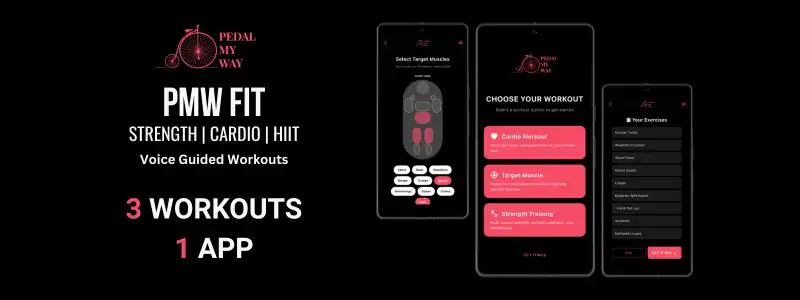
We also released a workout app for this exact reason. Take a look at the PMW Fit app – both on the web and Android OS.
Nutritional Baselines for Lean Muscle Development
Building lean muscle as a cyclist doesn’t mean bulking up or following a complex diet — it means giving your body the right building blocks to recover, adapt, and get stronger without adding mass that slows you on hills. The fundamentals are simpler than the fitness industry wants you to believe.
The framework that actually works anchors around protein timing, smart carbohydrate use, and consistent daily targets. No expensive supplements required.
- Hit 0.7–1g of protein per pound of bodyweight daily. This range supports muscle repair without turning every meal into a joyless routine. Spread it across three or four meals — lean meats, eggs, dairy, lentils, or tofu all count.
- Fuel rides with carbohydrates, not willpower. Carbs are your primary energy source for cycling and strength training alike. Focus on whole grains, fruits, and vegetables, especially on active days — never cut them entirely.
- Eat more on training days, less on rest days. This calorie cycling approach keeps your weekly surplus small while maximizing recovery when your body actually needs to rebuild.
- Don’t skip the post-ride meal window. Getting protein and carbs in within 45–60 minutes after a hard session meaningfully improves muscle repair and glycogen replenishment. Rice with eggs or Greek yogurt with fruit is genuinely enough.
- Prioritize whole food sources over supplements. Whole foods deliver micronutrients, fiber, and satiety that shakes simply don’t replicate.
On your next ride, log everything you eat (including snacks and drinks – soda, beer, etc.) for one full day and compare your protein intake against your bodyweight target — that single number will tell you more than any fitness quiz online.
Core Strengthening Exercises for Improved Bike Handling
Here’s what most cyclists get wrong about core training – they picture crunches and sit-ups, then wonder why their lower back is still screaming on hour three of a long ride. On a bike, you’re not doing sit-ups — you’re bracing against road vibration, holding position through climbs, and transferring power from your hips without leaking energy through a soft midsection. A weak core means your legs work harder than they need to, your handling gets sloppy on technical terrain, and fatigue hits faster.
The core strength cyclists actually need is about stability and anti-rotation, not flexion. These exercises train it the way riding demands — isometric, bracing-focused, and specific to the stabilizing muscles that keep your torso from flopping around while your arms and legs do their job.
- Dead Bug: Trains your deep stabilizers to maintain a neutral spine while your limbs move independently — exactly what happens when you’re grinding through a climb. Keep your lower back pressed flat throughout.
- Pallof Press: An anti-rotation exercise using a band or cable that directly mimics the lateral stability demands of cornering and crosswind riding. Your core’s job here is to resist movement, not create it.
- Bird-Dog: Builds anti-rotation and coordination from a hands-and-knees position. Think of balancing a cup of water on your lower back — your torso stays completely still.
- Side Plank: Targets the obliques and lateral stabilizers that traditional core work consistently neglects, keeping your hips level through thousands of pedal strokes.
Pick two exercises, add them to your next session twice a week — 3 sets of 30–60 second holds or 8–12 slow, controlled reps per side — and run them consistently for three weeks before layering in more. I’ve shared some of the full body workouts I do here.
Structuring Gym Workouts Around Your Riding Schedule
It took some time for me to incorporate strength training into cycling. Usually I’d just hammer a heavy squat session on Thursday, for example, then try doing a long ride the next day, thinking my legs would have gotten stronger, only to realize my legs felt like wet cement. The problem wasn’t the strength work — it was the timing.
What I learnt was that, stronger cyclist needs recovery to perform – putting your hardest gym sessions where they create the least interference with your quality ride days. Your body adapts during rest, not during the session itself. Here’s how to lay it out:
- Protect your hardest ride day completely. No lifting the day before, no gym session that same evening. That ride is your primary training stimulus, and everything else should serve it.
- Match intensity across activities. Pair a heavier strength day with an easier ride, and a hard interval day with a lighter or no gym session. Avoid maxing out both on the same day.
- Use same-day doubling wisely. If you must ride and lift on the same day, separate sessions by several hours — and ride first, lift later. Cycling on pre-fatigued legs from a gym session compounds injury risk.
- Limit full-body sessions to twice per week during riding season. Two well-placed sessions build and maintain strength without accumulating fatigue that bleeds into your riding.
- Listen to your body. If you wake up unusually fatigued, scale back the gym session or swap it for a recovery ride. Pushing through excessive fatigue is a fast track to injury.
This week, map your rides and gym sessions together in one place and honestly check whether your hardest efforts have enough breathing room around them.
Building Leg Power Without Adding Unnecessary Bulk
The fear of getting bulky stops a lot of cyclists from ever touching a barbell, and that’s unfortunate. The truth is, you can build explosive leg power — the kind that helps you climb stronger and sprint faster — without adding unnecessary size. The key is understanding the difference between hypertrophy training and strength training. High-rep, moderate-weight work done to failure is how bodybuilders add mass. That’s not what we’re doing here.
Lower-rep, heavier loading teaches your nervous system to recruit muscle fibers more efficiently without necessarily growing them larger. You get stronger legs, not bigger ones. Diet reinforces this: muscle mass requires a caloric surplus to grow significantly, so if you’re fueling for riding and recovery, your body simply won’t have the raw material to bulk up.
The following are some of the basic, but effective, exercises you can include in your workouts –
- Heavy deadlifts or Romanian deadlifts: Sets of three to five reps build posterior chain strength — glutes and hamstrings — without the volume that drives size.
- Bulgarian split squats: This unilateral movement exposes left-right imbalances and mirrors the alternating push of pedaling far better than a standard squat.
- Box jumps: Develop explosive power in your glutes, quads, and hamstrings, mimicking the quick bursts needed for climbing or sprinting.
- Step-ups: Build hip drive and knee stability under real load, with a step height around knee level to keep the movement cycling-specific.
- Nordic hamstring curls: One of the most effective tools for hamstring resilience, consistently linked to reduced injury risk.
Build one session around three to five heavy deadlift sets, one single-leg movement, and box jumps — after a couple of these workout sessions notice how your legs respond on the hills.
You Don't Need to Choose Between Strong and Fast
I was not able to make the connection between the gym and the bike initially. But once I started weight lifting, I realized they were never actually competing. The skinny-frame rider who adds targeted strength work doesn’t become a bodybuilder. They become someone who built a body that climbs harder, corners with more confidence, and doesn’t crumble after hour three on a long ride. That’s the whole point! Not aesthetics. Not a bigger squat number. Just a body that holds up better on the road.
The topics we covered, resistance training rationale, nutritional baselines, core work, structured workouts, and leg power without bulk, are meant to work together, not as a rigid program you follow perfectly. They are a framework you can use in your workouts/ lifestyle. Start small, stay consistent, and let the bike tell you what’s working.
Start adding some of the exercises recommended in this post. I am sure you will start seeing improvements that you thought were not possible.
Related Cycling and Training Content

Mukund Murali is the founder of Pedal My Way (pedalmyway.com), a cycling and fitness media brand reaching 50,000+ monthly visitors. He brings 20+ years of cycling experience spanning road, gravel, and mountain biking, with deep expertise in bike mechanics and repair. A CrossFit L1 and L2 certified trainer (2018–2023), Mukund combines strength training methodology with cycling performance to create evidence-based content for the everyday rider. He is the host of Ask The Pedalist podcast and creator of the PMW Fit workout app on Google Play.