What You’ll Learn in Heart Rate Variability for Cyclists: Recovery Tracking Done Right
- The Science of Recovery: What HRV actually measures in your autonomic nervous system and why it’s a far more accurate gauge of your readiness than just going by feel.
- Choosing the Right Tech: A breakdown of the best tracking devices and apps—from chest straps like the Polar H10 to wearables like Oura and Whoop—and whether ECG or PPG sensors are right for you.
- Interpreting Your Data: How to use a simple “traffic light” system (Green, Yellow, Red zones) to confidently adjust your daily training intensity, threshold work, and rest days.
- The Sleep Connection: Why sleep architecture is the “missing link” to overnight recovery, and how factors like screen time and alcohol directly tank your morning HRV score.
- Holistic Progress Tracking: How to tie your HRV data into a broader routine, with direct access to further resources on recovery strategies and tracking your overall progress.
Table of Contents
What HRV Tells You About Recovery
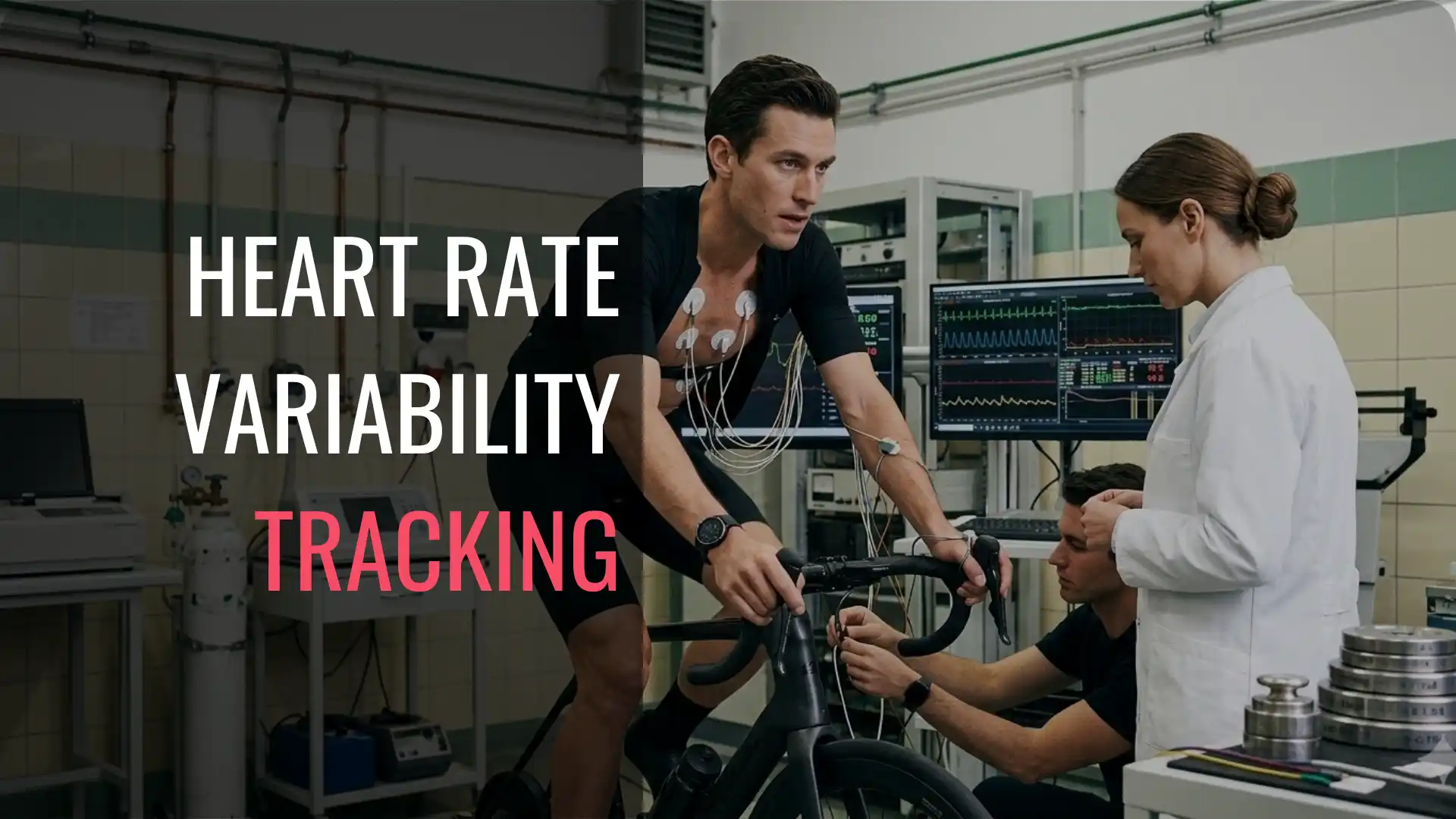
Heart rate variability (HRV) measures the fluctuations in time between each heartbeat, acting as a window into your autonomic nervous system (ANS). A higher HRV signals parasympathetic dominance, meaning your body is in a recovery-oriented state and primed for intensity. A lower HRV reflects sympathetic dominance, triggered by hard training, poor sleep, illness, or life stress.
For cyclists, HRV cuts through the guesswork of “am I recovered enough to train hard today?” Rather than relying on feel, it gives you an objective, physiology-based data point. Here’s what it can reveal:
- Over-training risk: A consistent downward trend in HRV is your early warning sign of overreaching before it becomes a bigger problem.
- Acute fatigue: A significant single-day dip after a hard ride is normal — it’s the failure to rebound that signals a real recovery issue.
- Illness onset: HRV often dips one to two days before you feel the first symptoms, as your body is already under stress fighting infection.
- Recovery effectiveness: A stable or rising HRV trend confirms your training load and recovery strategies are well-balanced.
- Broader stress response: Emotional stress, poor nutrition, and inadequate sleep all suppress HRV, not just hard training sessions.
One critical rule: baseline HRV is highly individual. Comparing your numbers to other cyclists is meaningless — only track against your own established range, using consistent morning measurements taken immediately after waking.
Best HRV Apps and Devices for Cyclists
- Elite HRV — A popular free app that pairs with any Bluetooth chest strap. Provides clear daily readiness scores and trends, making it easy to interpret your data.
- HRV4Training — Developed by HRV expert Dr. Marco Altini, this app uses your phone’s camera or a chest strap for measurements, with advanced analytics and integrations for Training Peaks and Strava.
- Whoop 4.0 — A dedicated wearable with continuous HRV monitoring, sleep analysis, and strain scoring built specifically around athletic performance.
- Garmin Connect with compatible watches — Garmin’s Body Battery feature uses overnight HRV data to estimate daily energy availability, making recovery insights easy to act on without extra apps.
- Polar H10 chest strap — The hardware benchmark most researchers rely on for raw HRV accuracy, compatible with multiple third-party apps.
- Oura Ring — Tracks HRV passively overnight, delivering a clear Readiness Score each morning without any active measurement required.
Tips for Choosing the Best HRV Apps and Devices for Your Riding
| Key Consideration | Why It Matters for Cyclists | Popular Tool Examples |
|---|---|---|
| 1. Sensor Accuracy (ECG vs. PPG) | Accurate raw data is the foundation of HRV. Chest straps (ECG) measure the heart’s electrical signals and are the gold standard for morning readings. Wearables (PPG) use light to measure blood flow and are highly convenient for continuous overnight tracking, though slightly more prone to movement artifacts. | ECG: Polar H10, Garmin HRM-Pro PPG: Whoop, Oura Ring, Apple Watch |
| 2. Measurement Protocol | You have two main choices: a dedicated 1-2 minute morning reading or automatic overnight tracking. Cyclists who want deep, actionable context often prefer morning readings where they can also input subjective data (muscle soreness, sleep quality). Those who prefer a “set it and forget it” approach favor overnight trackers. | Morning: HRV4Training, Elite HRV Overnight: Whoop, Oura Ring, Garmin (Body Battery) |
| 3. Ecosystem Integration | Your HRV data shouldn’t live in a silo. The best tools will automatically pull in your ride data (TSS, heart rate, power) from platforms like Strava or Garmin Connect, and push your morning readiness scores to coaching platforms like TrainingPeaks so you (or your coach) can adjust your intervals accordingly. | HRV4Training (excellent Strava/TrainingPeaks integration), Garmin Connect |
| 4. Actionable Insights vs. Raw Data | Some apps just give you a raw RMSSD number (the standard metric for HRV), which requires you to interpret your own baseline. The best apps for cyclists translate that raw data into a daily “Readiness” or “Recovery” score, explicitly telling you if you should push hard, do a Zone 2 ride, or rest. | Whoop (Recovery Score), HRV4Training (Daily Advice), Elite HRV (Readiness Score) |
| 5. Pricing Structure | Consider the long-term cost. Some ecosystems require a heavy monthly subscription fee to access your insights, while others only require a one-time app purchase or are completely free if you already own the compatible hardware (like a chest strap). | Subscription: Whoop, Oura One-time/Free: HRV4Training, Elite HRV (requires compatible strap) |

How to Adjust Training Based on HRV Trends
Knowing your HRV number is only half the battle — the real value comes from acting on it. Think of it as a daily report card from your nervous system. Rather than chasing a single “good” reading, focus on your 7-day rolling average as your personal baseline, then use a simple traffic light system to guide your training decisions.
- HRV above baseline (Green Zone): Your body is primed — go ahead with hard intervals, threshold work, or long challenging rides. Capitalize on these days when adaptation is at its peak.
- HRV within 5–8% of baseline (Yellow Zone): Accumulated fatigue is likely. Keep training but reduce intensity or duration — swap 2×20 minute threshold efforts for 2×10 minutes, or opt for steady Zone 2 riding instead.
- HRV significantly below baseline for 3+ consecutive days (Red Zone): This is a genuine overreaching warning. Prioritize active recovery, an easy spin, or complete rest.
- Consistent downward trend: Even if readings stay within your normal range, a multi-day slide signals it’s time to schedule a recovery week before deeper fatigue sets in.
- Sudden HRV spikes: Can indicate dehydration or illness onset — always cross-check with how you actually feel before treating it as a green light.
Use HRV as a guide, not a dictator. Review your HRV trend graph each week to plan your training load intelligently, ensuring you push hard when your body is ready and recover when it genuinely needs it.

HRV and Sleep: The Missing Link
If your HRV numbers are stubbornly low despite dialing in your training load, sleep quality is almost always the culprit. Your autonomic nervous system does the majority of its repair work during deep and REM sleep stages — think of sleep as the ultimate reset button. Even one night of poor rest can tank your HRV score the following morning, and HRV doesn’t lie about what your body experienced overnight.
Understanding this connection lets you make smarter training and recovery decisions. It’s not just about sleep quantity, but quality too. Tracking both metrics together creates a powerful feedback loop, giving you objective evidence to prioritize rest as seriously as any training session.
- Sleep duration matters: HRV drops measurably when sleep falls below seven hours, even in well-trained athletes.
- Consistent sleep schedule: Going to bed and waking at the same time daily anchors your circadian rhythm and produces more stable HRV baselines.
- Optimize your sleep environment: Keep your bedroom dark, quiet, and cool — even minor disturbances impact sleep quality and next-morning HRV.
- Limit screens and caffeine late: Blue light suppresses melatonin, while stimulants and heavy meals disrupt sleep architecture and reduce overnight recovery.
- Alcohol is a silent HRV killer: Even moderate evening drinking fragments deep sleep and can lower next-morning HRV by 10–20%.
Track sleep stages alongside HRV: Many devices monitor light, deep, and REM sleep — use this data to identify your personal patterns before adjusting training.
Recovery Tracking for Overall Wellbeing
Tracking your cycling progress is one of the most empowering things you can do for your training. When you move beyond average speed and start paying attention to meaningful metrics, setting smart goals, and analyzing real trends, every ride becomes a data point in a bigger, more rewarding story.
Start simple, stay consistent, and trust the process. You don’t need to implement everything at once — pick one or two strategies from this guide and build from there. Your future self will thank you for every ride you logged today. Now get out there and ride!
Related Cycling and Training Content
PEDAL MY WAY NEWSLETTER
Weekly training tips, cycling strategies, and fitness insights for sustainable performance.
No spam—just actionable guidance to help you train smarter.
FAQs About Heart Rate Variability for Cycling
Why does HRV matter for cyclists?
It gives you a daily snapshot of how your body is handling stress and recovering from previous rides. A higher HRV generally means your nervous system is balanced, recovered, and ready for a hard training session. A lower HRV suggests your body is working hard to recover, meaning you might need an easy spin or a rest day to avoid overtraining.
When is the best time to measure it?
Consistency is key. The most accurate way to establish your baseline is to measure it first thing in the morning, right after waking up, before you check your phone or get out of bed. Many modern cycling wearables, chest straps, and smart rings also track it automatically overnight.
What factors besides cycling can cause it to drop?
Your nervous system responds to all types of stress, not just physical exertion on the bike. Poor sleep, alcohol consumption, work stress, dehydration, poor nutrition, and impending illness can all cause a noticeable dip in your daily reading.
How should I adjust my cycling plan based on the reading?
If your HRV is within or above your normal baseline, you are clear to tackle high-intensity intervals, FTP tests, or long, demanding group rides. If it drops significantly below your baseline, it is a clear biological signal to swap that heavy workout for Zone 1 or Zone 2 recovery rides, or to take a complete day off.

Mukund Murali is the founder of Pedal My Way (pedalmyway.com), a cycling and fitness media brand reaching 50,000+ monthly visitors. He brings 20+ years of cycling experience spanning road, gravel, and mountain biking, with deep expertise in bike mechanics and repair. A CrossFit L1 and L2 certified trainer (2018–2023), Mukund combines strength training methodology with cycling performance to create evidence-based content for the everyday rider. He is the host of Ask The Pedalist podcast and creator of the PMW Fit workout app on Google Play.